Wednesday, August 14, 2013

Pitmen Painters and the Idea # 187 is The Baroque

Play poster
On Saturday we went to see Pitmen Painters at Richmond on Thames theatre it's a play based on a true story about the Ashington Group of Miner Artists (not Minor Artists) .
 Lee Hall  who wrote Billy Elliot got the idea after reading an article in the Guardian  and then buying the book "Pitmen Painters: The Ashington Group 1934-1984" by William Feaver .
Pitman painting
The story is  about a group of miners who pursued  an interest in art under the auspices of the WEA their teacher finding they had little to inform them of art got them to paint and the experience was life changing for them.

Of course the play uses quite a bit of artistic licence, reducing the number in the group and creating a (female) patron who offers the most talented of the miners a way out but the play was well realised and a strong message came through of the power of art and working class solidarity.
(Note: Nice performance by the Understudy Jennifer Gabriele in the role of Helen Sutherland on Saturday 10th August)

Big Idea 187 is The Baroque

Conversion of St Paul Santa Maria del Popolo,
If someone asks you what Baroque means you've got a couple of choices when you answer - one possibility is the irregularly shaped pearls but chances are though they're really on about a big art movement ..which relates to   an elaborate style of music, architecture, and art of the 17th and 18 centuries-  The Baroque style or period.

From around 1600  to 1750 the was the Baroque epoch in European visual arts, encompassing architecture such as the Palace of Versailles and the art of artists like Caravaggio whose  Conversion of St Paul Santa Maria del Popolo, Rome  (1601) is such a fine example of the genre.

Palace of Versailles (near Paris)
Originating in Italy the Baroque arts falls into the period of Counter-Reformation led by the Catholic church against the Protestants. Much of the Baroque art, reflects the reaction to the dominant Mannerism, as well as the social turmoil of the time. According to the Council of Trent and the Catholic church artworks should be a clear, intelligible subject realistically interpreted in order to stimulate piety. This was part of the reason that the artwork turned towards naturalism, becoming emotionally engaging and intense.

Sunday, August 11, 2013

French Style Ealing Eatery & Big Idea #186 is 'The Novel'

A table -Mais Oui
On Friday we had a meal at relatively new  Restaurant in Pitshanger Lane - It’s a French eatery trading under the name Chez L'Ami David and although it had a  limited menu this was no bad thing the food and wine being suitably French, tasty and well cooked. The Maître D was full of  the French variety and very much on the case. The restaurant has a special Birthday Menu to celebrate a year of trading and it offers excellent value for money.
Having been in a location that was recently  a Thai restaurant and amongst other cafe's it's well poisoned but Reviews of this place (like so many) are mixed, the Ealing Gazette was particularly harsh but we'd definitely go again.

Big Idea Number 186 is 'The Novel'


A novel is defined as  A fictitious prose narrative of book length, typically representing character and action with some degree of realism

Prior to the Novel assuming hegemony of the literary works the epic poem was the dominant form but around 300 years ago this changed and a novel which is considered to have  led to this change was  the succcesful Novel Don Quixote satirising what had gone before in those overblown epic poems.
Daniel Defoe, a Brit was another big figure in creating the modern novel with works such as Robinson Crusoe (this book said to set on  Caribbean island of Tobago.).
Other key and important figures include Charles Dickens and (for me anyway) Graham Greene who specifically denoted some of his works as Entertainments.
The last 100 years has seen much stretching of the form and although some devices now scream out cliché the novel retains strong popularity amongst large sections of the reading population be it in a traditional book or kindle type device .


Friday, August 09, 2013

Gardeners Gift -Biodegradable Pot Maker and Big Idea 185 is Allegory

reuse newspaper
One of the gifts I received today (as well as that most precious gift, the gift of li..) was a device for making biodegradable pots from old newspaper - The Paper Potter. The Potter looks like fun, seeds and seedlings can be planted out at the appropriate time and the pot will disappear into the soil.

The wooden 'Potter' designed to form the pots is made from FSC oak so you can be assured it has come from renewable environmentally friendly sources. The pots are simple to put together and solid enough to contain delicate seedlings but lack the ability to support bigger plants.
The pots are great in  allowing the plants to be transplanted without damaging the tender seedling roots.
The Nether Wallop Paper Potter is (they say) robust enough for the seasoned gardener.

Big Idea 185 is Allegory


The word allegory is derived from the Greek words meaning “other” and “to speak in public.” The meaning of the allegory is sometimes communicated through the use of symbolic figures or other symbols. The associations of the allegorical figures or symbols with other elements in the work can occur in the mind of the viewer and convey a meaning beyond the literal representation or it might be pointed out to them for them to get the second meaning.

Here comes spring!
Literary works such as  Pilgrim's Progress and Animal Farm are said to be allegorical that is the books can be analysed on two levels. The main obvious one, and the one below the surface so Animal Farm is actually an allegory that uses animals on a farm to represent the overthrow of the Russian Tsar Nicolas II, the actions of Stalin and the revolution in Russia (1917).
The struggles of the animals on the farm can  be viewed as a metaphor for how greed and indifference corrupted the Russian revolution and the dangers that  occur without a smooth transition to a government of the proletariat.
Allegories can also be seen in visual works such as  the painting “La Primavera,” by the Italian Renaissance painter Sandro Botticelli this used various Greek gods, goddesses and nymphs to depict the  soon to be spring.
Life of Pi is a film and book that is said to be allegorical - look at Yann (who wrote life of Pi) talk on the subject here.

Thursday, August 08, 2013

Blood Pressure checks and Idea today is Imagery (#184)

BP measuring is easy
Reasons to be cheerful - today 5 years on from my local GPs surgery asking me to attend and have my blood pressure checked I again attended (seems they like to do this on a regular basis) - good news is that I'm told that it is normal (normal is fine in this case).
Normal blood pressure for a man of my age is around 120/80 and BMI which is a measure of the ration of weight to height should be between 18.5 - 25.
We regularly check our BP at home so this was not a great surprise but nevertheless good news.

When I look around I realise I am incredibly lucky (at present anyway) particularly with respect to my health and well-being - I suppose it is a mixture of things that means I can enjoy this status but it is fleeting (as far as I know) so should try and make the most of it...


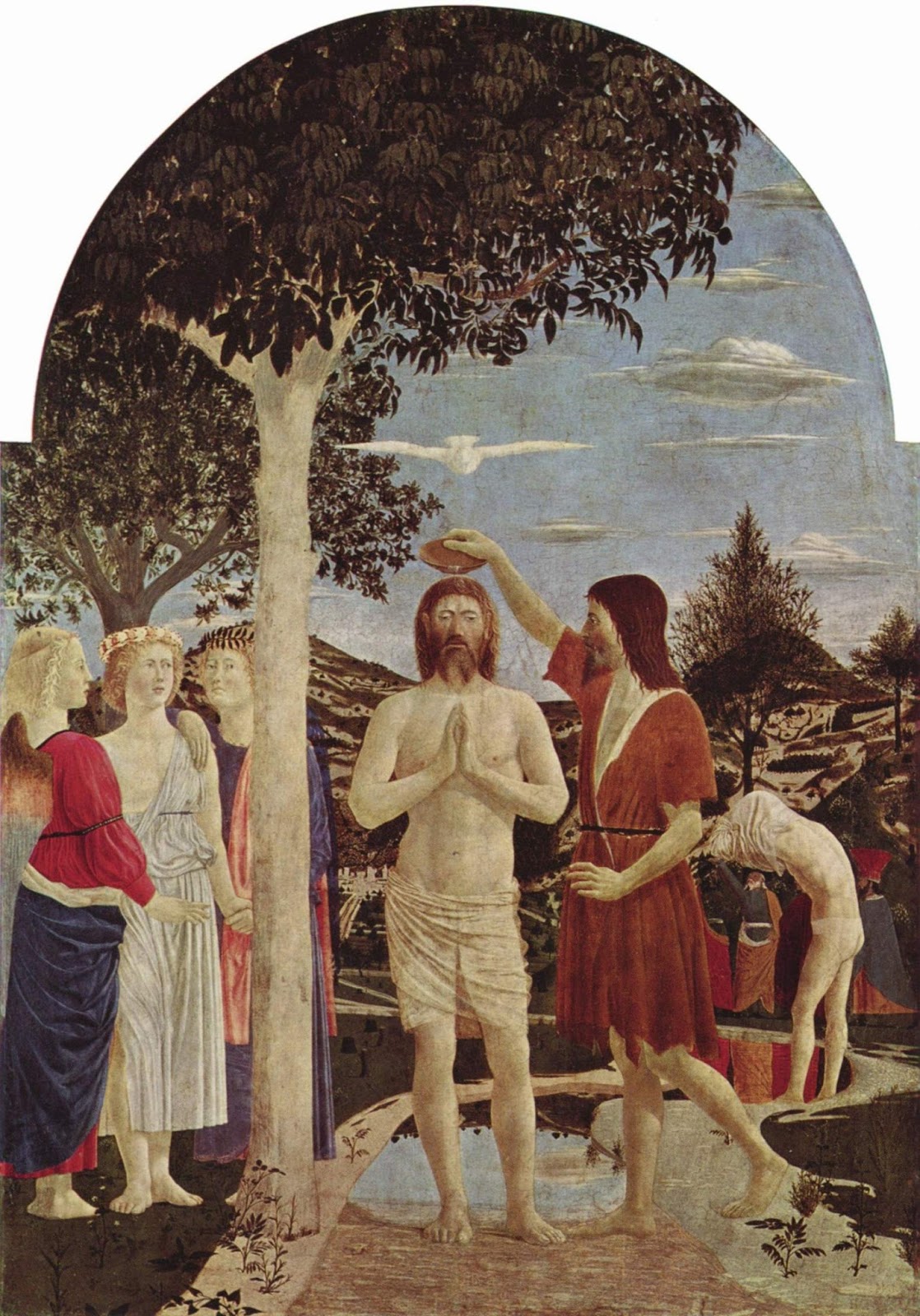
Holy Spirit denoted


Idea number 184 is Imagery


In written as well as visual media Imagery is important.
When we look at books we often see use of similes (example my lawn is like billiard table) and metaphors (I'm going to go and mow the billiard table).

Many schools of art (visual) use images as denotations - Crofton gives the example of a white dove standing in for the Holy Spirit in Medieval and Renaissance works of art. You can see this in The  Baptism of Christ
from the 1450s by  the artist, mathematician and geometer Piero della Francesca.
Shakespeare (and others in literary and visual arts) can subvert the use of imagery as in 'Shall I compare thee to a summers day? (he goes on to say she's better)