Showing posts with label Holbein. Show all posts

Tuesday, February 27, 2018

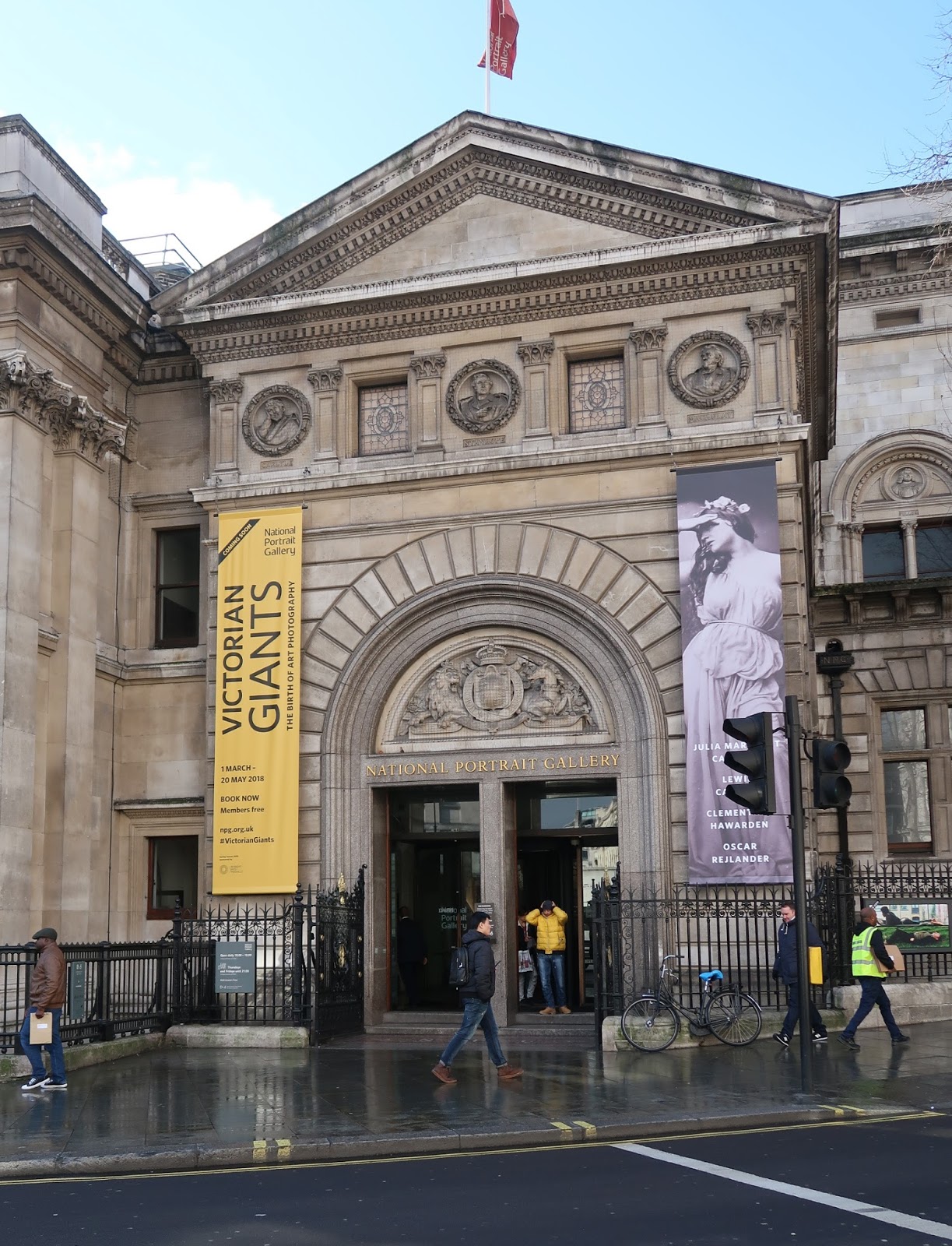
National Portrait Gallery - CityLit course

NPG not the poor relation of The National

Yesterday was the first session at London's National Portrait Gallery with city Lit Course VB151 - and what a good time I had with it.

It was a cold day but worth making the journey!


A Gull made it into London too


As I found with the last Gallery tour course (around the corner at the National Gallery) Leslie Primo, the course leader is not only a talented communicator on Art he is also very well organised when it come to running classes - this time he was there with handouts and registers and explained the structure which is a chronological run through of some of the important works at the NPG.


 A good mixture of people in attendance and as well as those who have paid and enrolled there were a number f visitors who latched on to the explanations.


The first session was very much about portraits of  English Kings, Queens and some nobility.

A selection of paintings of English Royalty

Early paintings (on wood rather than canvas) were not attributed to an 'Artist' and were often copies of other likenesses doing the rounds.
A more 'natural' approach

As painting developed European influences meant that standards were improved and new techniques became accepted, some artists worked on canvas and became known for their particular approach.

There was (it was agreed) even then a tension between imported talent (artists sometimes  fleeing religious persecution)  and bringing on 'homegrown' artists.

Many of the artists from Germany and the low countries were able to show great skill in their work, they often had a more natural approach to their subjects  and by virtue of their talents  became 'court' painters (like Holbein) often taking English nationality (to lower their taxes).

It was really interesting to see a number of paintings of Elizabeth I which reflected the audience they were aimed at (some personified her as England).

Not all paintings made reflected how she aged or her waist size!


A Portrait of Elizabeth 


Tuesday, December 05, 2017

National Gallery Mop Up

National  Gallery in the November Sun

Well last Tuesday was the final visit to London's National Gallery for the rather excellent 2017 CityLit Course, Looking at Paintings  (still two more lessons to go but at Tate Modern and Britain).

Having visited the 'Genre's as proscribed by the French Academy  it was bit of a 'mop up' of works looking at the truly impressive Ambassadors by Holbein (complete with its own Memento Mori skull), the satisfying Kitchen Scene with Christ in the House of  Martha and Mary by Diego Velasquez (nice how this connected with last week's painting of 'Fire' by Joachim Beuckelear ).


Paolo Veronese's 'Four Allegories of Love
So much to see
Little messages


Amongst the Paintings we'd not captured so far were  The Ambassadors (Holbein) was the most impressive, we also spent time looking at  Paolo Veronese's 'Four Allegories of Love' which I wasn't too sure about.

The painting is not helped by the deterioration of the smalt  and for me  it would be good to see them all  as they should have been exhibited (high on a ceiling).


Animals -Stubbs's  WhsitleJacket 

Also good to see Martha and Mary having a sulk - Velasquez 


We were also interested in Animals and Stubbs's  Whistlejacket from 1762 - oddly this painting doesn't look at all dated (perhaps because of the lack of background or other objects/people save for the horse) - Although the fashion was to show jsut the animal I can't help but wonder if it's finished.

George Stubbs was born in Liverpool and lived to the ripe old age of 81.

We took a look too at the floor mosaics at the Gallery entrance (not strictly paintings!) they are by the Russian born Artist and Poet Boris Anrep, the mosaics show 'The Labours of Life, The Pleasures of Life, The Awakening of the Muses and The Modern Virtues'.

One of Anrep's mosaics


Tuesday, October 25, 2016

Memento Mori Adding details and Red 7

It's that time of year
It's only a couple of weeks or so before Helen and I take up our temporary residency in Bond Street (and a week to the end of my 365 Project).


As well as mounting and framing my photographic prints  I'm trying to put together a sheet about each of the photo's I'm offering for sale  - this triggered partly by the fine details I see at some exhibitions) as opposed to those with nothing) but also as I find more about the subjects and reflect on the results.


A page about the picture


First is my own personal capture of a shop window's Memento Mori - this is a really rich area and encompasses one of my favourite Paintings at London's National Gallery  by Holbein (The Younger) The Ambassadors and the subject of Noah Scalin's own 365 Project .


I rather like this one - will others?


Red 7


Happy Birthday Debbie- what better way to mark it than with a 'red' gift.

.. oh yes, The Present's a Gift.

Friday, June 03, 2016

We all agreed a good No 5 session and Red 151

So around halfway through the National Gallery course run by City Lit  with course leader Leslie Primo and I think we were all (including some folks just listening in) were pretty unanimous that it was a particularly good session.

Ahead of the paintings a brief chance to reflect on what we've already gained, for me one of the key things is  less is more (and the inverse too) - it's not about squeezing in many pictures but more about squeezing more out from a lesser number - of course a lot is interpretation but the business of 'decoding' actually  means you're engaging.
Poor cupid

So to the first artist and one I'm slightly embarrassed to say I'm not very familiar with - Lucas Cranach, The Elder (his son to became an artist and was inevitably labelled 'The Younger' .

There's so much that can be gleaned from something as simple as the size of the picture (this was smallish so for personal enjoyment) , as  we looked at 'Cupid complaining to Venus' Leslie asked our first not  over considered comment - mine was about how Venus's eyes met ours (the viewers )- 'the male gaze' but lots of other interesting points that we shared as a group and considered.

The fact that the nude and un-hairy Venus had a hat (which looked a little like a personal part of the body), the fact that nearly 500 years after the painting was completed London Transport had been uncomfortable with the use of the picture to publicise an exhibition.
Johann Friedrich and son by Cranach


Adjacent to Cupid complaining to Venus were pictures that reflected Cranach's position in society and how changes were reverberating in the established church .

The church was beginning to look at how images of a religious nature  were perhaps becoming overly concerned with 'craven images'.
Skill -only viewable at some angles

The next artist to be considered was Hans Holbein and his endlessly fascinating  'The Ambassadors' - first it's significance is marked by the fact that the gallery has a projected  'false' wall and skirting addition so that the skill of the artist can be seen in his rendition of the skull.
 
The brilliance of the work is almost matched by the intellectual skill shown in loading the painting with so many coded messages.

Leslie pointed out that the work probably commissioned by one of the French ambassadors shown was about humility, the skull showing despite riches and intelligence mortality was ever present (Leslie pointed out a connection with the more current work  Damien Hurst's 'Skull)'.

The fact that the music displayed can be played and other details of the artefacts shown can be extracted.

Ambassadors - endlessly fascinating
A familiar face

We also looked at Quinten Massys' the picture commonly known as The Ugly Duchess  (which inspired the illustrator of Alice in Wonderland. This painting says much about how women of a certain age were viewed in the 1500's although beyond the satire on 'Mutton dressed as Lamb' there's a possibility that the subject was suffering from Paget's Disease.


It has not been possible to identify many artists and when it is clear that  several works were created by the same artist a generic sort of name is attached to the painter - such is 'The Master of Delft'  who is the named creator for The Crucifixion - here  is a painting that puts to bed the lie that early work is not 'sophisticated' , this painting uses identifiers (colours here) to pull together a narrative that does not read from left to right across the Triptych but the story of Jesus on the cross and his defilement can be clearly seen. 


A big and complex work that tells a biblical story


Red 151

When I was a child there were many confections that would be considered questionable now - things like Candy cigarettes - we still have wine gums and they've still got things like Port' written on them - children be warned Port is not as good as Wine Gum 'Port'

Down to a 'Wine Art'