Showing posts with label NPG. Show all posts

Monday, March 26, 2018

Last outing with CityLit - Intro' to The National Portrait Gallery

Five weeks really isn't enough when you're having fun - but as they say all good things to come to an end and Course Leader Leslie Primo pretty much brought us up to date.


So the last day of my course at the Portrait Gallery -and  again our leader had to make some changes as work was going on in the gallery.

We included after looking at the span of time  reflected in portraiture development  (see further below) a viewing of a bold modern portrait of Dame Eileen Younghusband by Sir Kyffin Williams  - this was both formal and intimate in a 20th century sort of way.

A nice display at NPG shows evolution from Ingres  via Sickert 


 I enjoyed spending time looking at and discussing the Sickert - he is one of my favourites, but not sure how successful this Self portrait example is. The thoughts were that the effect of press photography is a big influence on him here.
Walter Sickert used the press 


 For me I thought I'd begun to understand something of portraiture but modern practice and expectations are confusing me - I'm not so excited by works like Bomberg and Auerbach - in fact I prefer the effect of the older works like that of Ingres.

A historic spread across the Years (to Auerbach)

 The last pictures we looked at were a painting of Anna Wintour by Alex Katz an early self portrait by the modern British/Nigerian artist Ofili (1991) - (First heard about Chris from Nick Pearson nearly 5 years ago) not sure that these really represent progress!

A Self Portrait -Chris  Ofili 

Fashion Guru Anna Wintour - something about Clebrity?


Oh yes and here’s a rather good picture of the late Sir Ken by David Cobley which I noticed and I do like the trick used here (not uniquely) where a mirror gives us the chance to see more than one side of the subject.

The recently departed Sir Ken Dodd by David Cobley

Monday, March 19, 2018

The Artist is Present (week 4 of the NPG Citylit course)

What really impressed me today was the depth of knowledge and ability to think on his feet of our Course leader for the CityLit Course at The National Portrait Gallery.

As always Leslie Primo was there with notes for today's paintings but unbeknown to him part of the gallery was not available until 11:00 (half an hour after the start of the session).


So Leslie just adjusted and spoke with us about some other interesting works -  namely Anne of Denmark (by John de Critz the Elder) - which I liked and King James I of England and VI of Scotland by Daniel Mytens (which I'm less inclined to admire).

These two were again non-native painters from the 'low' countries who worked in England.

King James I of England 

Anne of Denmark


The reason for the great detail in the portrait of Anne was explained to us as follows :-

Tapestry was more highly valued than painting at the time of the commission and the artist captured detail of the carpet, chair and her clothes to the point  where it could almost pass for material rather than paint  -to me I thought there was a connection with the work of Klimt, perhaps because of the full length and somewhat flat-sh style used?


Job ben Solomon - a slave who was freed


The next picture we looked at connected with last weeks pictures and theme of slavery -it was a William Hoare painting of a a Muslim cleric Job Ben Solomon who was captured and enslaved in America (It's the Koran around his neck)   he was subsequently given his freedom by a result of funds raised by the  'Public' in England.


The painting by Hoare an English artist had clearly set himself a challenge in capturing the dignity and also the skin tones of the sitter - for me he met the challenge well.


After the interruption to Leslie's plans we returned to look art the works he had scheduled, mainly works around the Victorian era - here I fond the works less engaging being more (to me) rooted in 'reportage' and propaganda .

 The biggest culprits being  an imagined (or made up) portrayal of  Queen Victoria bestowing a bible in 'The Secret of England's Greatness' (1863) by Thomas Jones Barker, almost as saccharine is the tableau style work showing an almost spectral saint like  Florence Nightingale in the work by Jerry Barrett called The Mission of Mercy: Florence Nightingale receiving the Wounded at Scutari.


The Mission of Mercy: Florence Nightingale receiving the Wounded at Scutari


What we were seeing in some of these works was almost a collage of Newspaper images colourised and some work better than others, another of Jerry Barrett's is the painting of Victoria visiting the war wounded has had little care in the scale and direction of view of many of the extras behind the Queen and her family.


Queen Victoria's First Visit to her Wounded Soldiers (1856) - for me the extras don't work 

The highlight for me this week though was undoubtedly Dame Laura Knight's self portrait - I'd seen this before (pre the course)  and thought it was great but having spent some time looking at it with the group I realise now some of what is going on (and like it even more for the extra 'layers').

Leslie explained the 'Artist is Present' (and of course mention was made of Marina)  phrase and also mentioned Yoko Ono's 'cut piece' (it's not only formal art he knows about!).

But here the artist is present at many levels and this was a ground breaking work when it appeared at the time of the suffragettes struggle for 'The Vote'.

But is's witty and skilful too


The Artist truly is present - Dame Laura Knight's taboo busting self portrait of 1913 


Monday, March 12, 2018

Slavery and more at The National Portrait Gallery


Yesterday and at the National Gallery again - and we saw some examples of Portraits which were connected with Britain's involvement in the slave trade -Leslie the course leader reminded the group how England faced two ways on Slavery amassing large amounts of money but in some ways being  disapproving of the practice.

 The first portrait of  Lord Chief of Justice (William Murray) who ruled against the right of recapture of a black slave. This painting was by John Singleton Copley an Anglo American artist.


Lord Chief Justice


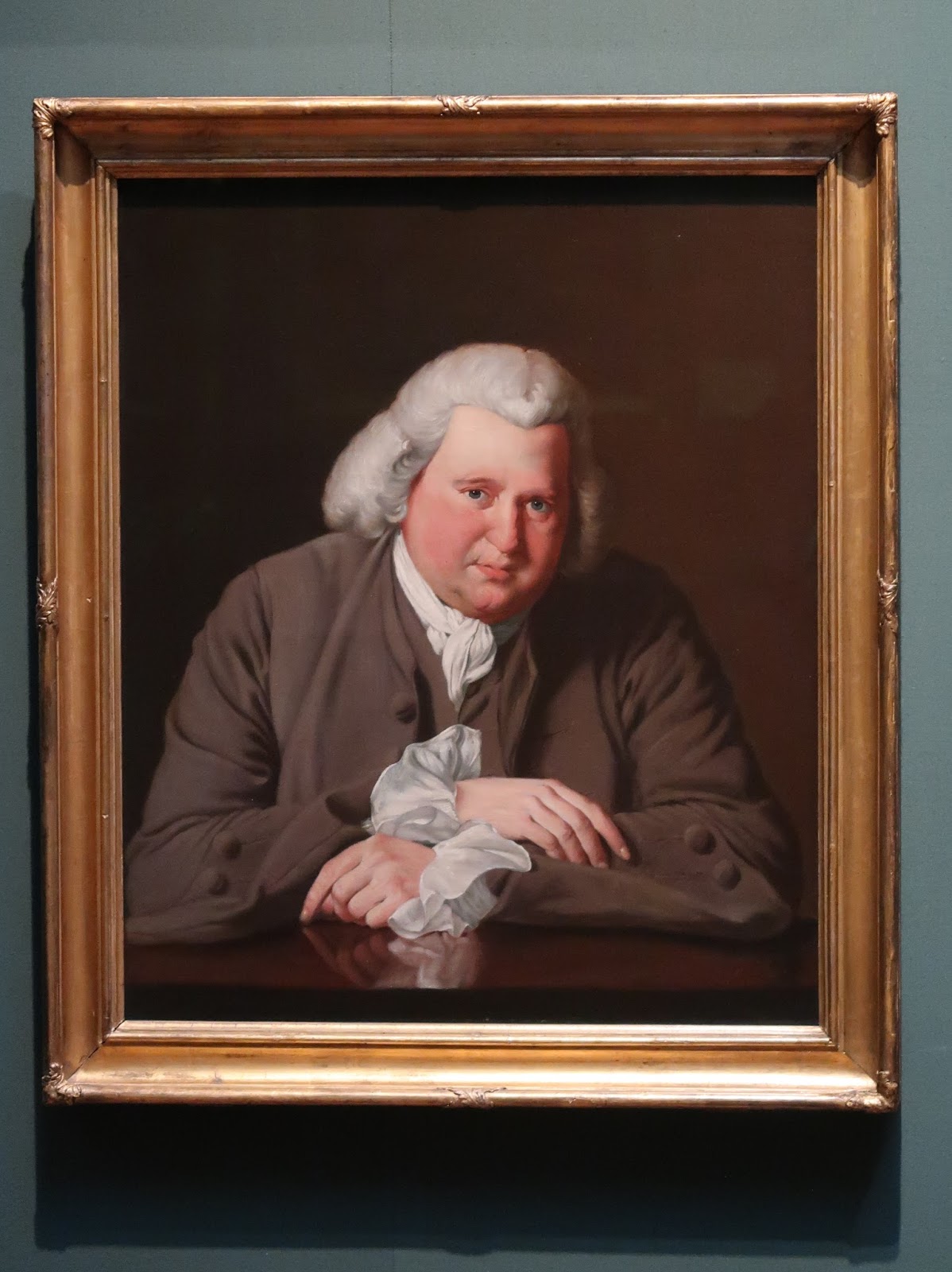
 My favourite of the paintings  was probably the portrait of Erasmus Darwin (related to Charles Darwin) by Joseph Wright of Derby (I like the reflection of the sitter's hand in the table) - this painter is one of my favourite English Painters.


Erasmus Darwin (Physician)  by Joseph Wright of Derby - look at the reflected hand

 I also liked the painting of Mary Lloyd by George Romney - the Gallery has hung this on the other side of an arch from a rather mannered self portrait by the Swiss (female) artist Angelica Kauffman.

and Mary Lloyd  by George Romney

A self portrait by Angelica Kaufman 


 The painting by Haydon is less successful as art but a useful documentation regarding the feeling amongst abolitionists particularly Quakers.

Haydon struggled with this work and it could have been one of the difficulties and  a contributory factor around his taking of his own life


Visitors take a look at a meeting of The Anti Slavery Society Convention - 1841 by Haydon 

And a panorama of a wet Trafalgar square by me..

A synthesised view

Tuesday, February 27, 2018

National Portrait Gallery - CityLit course

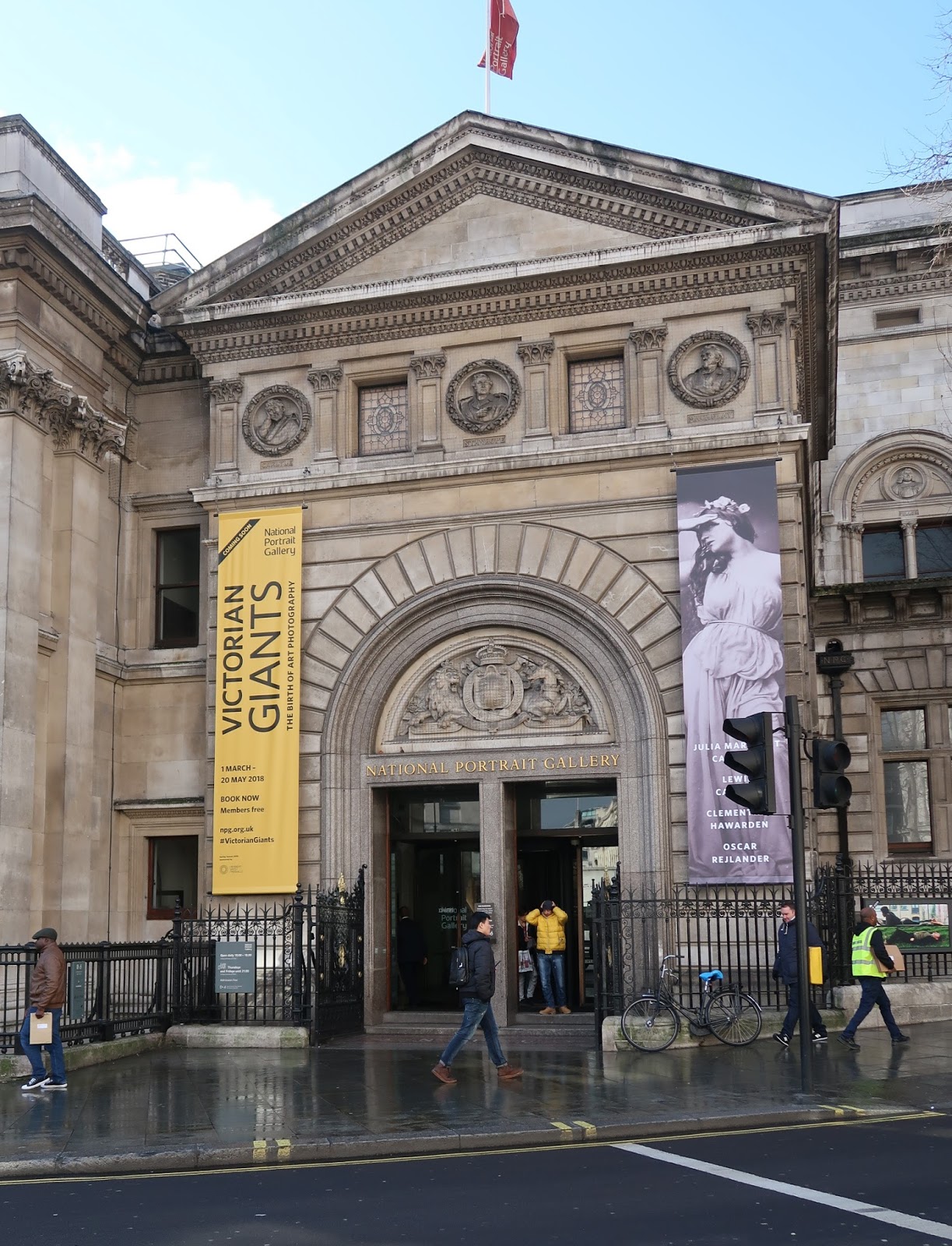
NPG not the poor relation of The National

Yesterday was the first session at London's National Portrait Gallery with city Lit Course VB151 - and what a good time I had with it.

It was a cold day but worth making the journey!


A Gull made it into London too


As I found with the last Gallery tour course (around the corner at the National Gallery) Leslie Primo, the course leader is not only a talented communicator on Art he is also very well organised when it come to running classes - this time he was there with handouts and registers and explained the structure which is a chronological run through of some of the important works at the NPG.


 A good mixture of people in attendance and as well as those who have paid and enrolled there were a number f visitors who latched on to the explanations.


The first session was very much about portraits of  English Kings, Queens and some nobility.

A selection of paintings of English Royalty

Early paintings (on wood rather than canvas) were not attributed to an 'Artist' and were often copies of other likenesses doing the rounds.
A more 'natural' approach

As painting developed European influences meant that standards were improved and new techniques became accepted, some artists worked on canvas and became known for their particular approach.

There was (it was agreed) even then a tension between imported talent (artists sometimes  fleeing religious persecution)  and bringing on 'homegrown' artists.

Many of the artists from Germany and the low countries were able to show great skill in their work, they often had a more natural approach to their subjects  and by virtue of their talents  became 'court' painters (like Holbein) often taking English nationality (to lower their taxes).

It was really interesting to see a number of paintings of Elizabeth I which reflected the audience they were aimed at (some personified her as England).

Not all paintings made reflected how she aged or her waist size!


A Portrait of Elizabeth 


Thursday, December 07, 2017

Taylor Wessing Prize at NPG

An answer to painting?

As I started to write this must say I was rather surprised to find that it's about 3 years since I went to see the winners of the Taylor Wessing Photographic Portrait competition at London's National Portrait Gallery.

The good news is that I think the quality this year  is even higher than before and the subjects yet more engaging.


Goodness how the judges choose - technically they all brilliant to me - but the ones I especially liked were:

1) Fleeing Mosul by Abbie Trayler-Smith (it got second prize) despite the sad subject the work is beautiful and so painterly, the colours are out of this world.

2) Minecrafting by Hania Farrell is another photograph that really did it for me, what was great about this one was the way it referenced works like the recently viewed (by me)  Velasquez's Kitchen Scene with Christ in the House of Martha and Mary (also seen last year).

And the third picture (and a big part of the reason I made the journey into town) was the really exciting...

3) 'One of them is a Human..' by Maija Tammi - what's so exceptional about this is that it's a portrait of Erica (an android) - Tammi is a Finnish artist who has worked and studied in America as well as Finland.

The idea of taking pictures of an Android seems almost a visual 'Turing test' and alerts us to issues that will become more and more applicable as technology progresses.

To be honest the visit to this exhibition really livened me up and made me enthusiastic to make more photographic  experiments myself.

[I was also intrigued by how many of the Portraits' had the subject so centrally]


Monday, May 23, 2016

Dieter Meier talks and Red 162

The event at London's Prestigious NPG
When I got into the National Portrait Gallery's basement lecture theatre and heard Tom Hunter (the interviewer for the session) ask Dieter Meier (the interviewee) prior to the session if he was a Jungian? (the answer was not really) - I knew I was going to be party to a great conversation.

Dieter spoke about many thing including  what a big problem gambling had been for him as a young man and how he'd become a conceptual artist - making works about various things for example  a performance in New York where he counted items (it was about free will) and the occasion he bought Yes-ses and No-es (about the same number of each as well as an odd 'Ohio').

Good to see he's lost the ponytail.
Dieter spoke of his musical  collaboration with non-musician Boris Blank and that they are to perform again after about 35 years - the influence of the Yello project is a big one in the electronic and dance world, Dieter mentioned how their first record broke out via Black Music radio in the USA.


Dieter gives good quote (not necessarily his but .. - two I picked up on, one on not being religious but welcoming Jesus's instruction as a way into art to 'become as Children.. '

and the other he said was a lone climber's autobiography - The conquering of nothingness.

The man was a lesson in how to age gracefully and happily - he retains an interest in wine growing in Argentina and a new type of chocolate production but remains quintessentially a Swiss one off.

Red 162


Back in the natural-ish world for a red pomegranate

Eat lots of different colours they say

Thursday, December 18, 2014

Taylor Wessing prize at National Portrait Gallery and printing

A lesson in portraiture

Went to see some great Photo's on show at The National Portrait Gallery.

What was staggering about the best of these pictures was the detail and quality- the focus and depth of field illuminated, one can imagine the detail  the photographer wished to highlight.


My favourite was  Ángel Nieto by Ben Stockley but the Dog and Boy by Laurence Cartwright was remarkably evocative (for me) of youthful holidays also with children and dogs was the winner a small child, Konrad Lars Hastings Titlow being held (The Photo' is by his father David Titlow).

There's also a revealing picture of Silvio Berlusconi (more on him here)


After visiting the Taylor Wessing exhibition at The National Portrait Gallery (a bargain at £3) as well as realising how great some photographic portraits can be I have learned a little about printing noticing that as well as Inkjet some prints were labelled as Colour Coupler Printer  .

I hadn't realised that the C-Print I'd seen on the Title and  Details of prints when shown was actually an abbreviation of Colour Coupler Printer.

This in fact refers  to a photographic print made from a colour negative using the same extremely light-sensitive silver salts as found in silver gelatin prints,  the silver salts though  'couple' with coloured dyes to form these potentially high-resolution prints.

The prints are often able to show very fine detail and the continuous tone resolution is equivalent to a 4000 dpi printer, finer than film grain, with no 
visible dots, 
Colour Coupler Printers produce a wide colour Gamut and accurate fidelity no inkjet, dye sublimation or electrostatic printer can get close to this degree of detail - so there you go.

The Edith Cavell statue just across the road from the NPG