Showing posts with label Leslie Primo. Show all posts

Monday, March 19, 2018

The Artist is Present (week 4 of the NPG Citylit course)

What really impressed me today was the depth of knowledge and ability to think on his feet of our Course leader for the CityLit Course at The National Portrait Gallery.

As always Leslie Primo was there with notes for today's paintings but unbeknown to him part of the gallery was not available until 11:00 (half an hour after the start of the session).


So Leslie just adjusted and spoke with us about some other interesting works -  namely Anne of Denmark (by John de Critz the Elder) - which I liked and King James I of England and VI of Scotland by Daniel Mytens (which I'm less inclined to admire).

These two were again non-native painters from the 'low' countries who worked in England.

King James I of England 

Anne of Denmark


The reason for the great detail in the portrait of Anne was explained to us as follows :-

Tapestry was more highly valued than painting at the time of the commission and the artist captured detail of the carpet, chair and her clothes to the point  where it could almost pass for material rather than paint  -to me I thought there was a connection with the work of Klimt, perhaps because of the full length and somewhat flat-sh style used?


Job ben Solomon - a slave who was freed


The next picture we looked at connected with last weeks pictures and theme of slavery -it was a William Hoare painting of a a Muslim cleric Job Ben Solomon who was captured and enslaved in America (It's the Koran around his neck)   he was subsequently given his freedom by a result of funds raised by the  'Public' in England.


The painting by Hoare an English artist had clearly set himself a challenge in capturing the dignity and also the skin tones of the sitter - for me he met the challenge well.


After the interruption to Leslie's plans we returned to look art the works he had scheduled, mainly works around the Victorian era - here I fond the works less engaging being more (to me) rooted in 'reportage' and propaganda .

 The biggest culprits being  an imagined (or made up) portrayal of  Queen Victoria bestowing a bible in 'The Secret of England's Greatness' (1863) by Thomas Jones Barker, almost as saccharine is the tableau style work showing an almost spectral saint like  Florence Nightingale in the work by Jerry Barrett called The Mission of Mercy: Florence Nightingale receiving the Wounded at Scutari.


The Mission of Mercy: Florence Nightingale receiving the Wounded at Scutari


What we were seeing in some of these works was almost a collage of Newspaper images colourised and some work better than others, another of Jerry Barrett's is the painting of Victoria visiting the war wounded has had little care in the scale and direction of view of many of the extras behind the Queen and her family.


Queen Victoria's First Visit to her Wounded Soldiers (1856) - for me the extras don't work 

The highlight for me this week though was undoubtedly Dame Laura Knight's self portrait - I'd seen this before (pre the course)  and thought it was great but having spent some time looking at it with the group I realise now some of what is going on (and like it even more for the extra 'layers').

Leslie explained the 'Artist is Present' (and of course mention was made of Marina)  phrase and also mentioned Yoko Ono's 'cut piece' (it's not only formal art he knows about!).

But here the artist is present at many levels and this was a ground breaking work when it appeared at the time of the suffragettes struggle for 'The Vote'.

But is's witty and skilful too


The Artist truly is present - Dame Laura Knight's taboo busting self portrait of 1913 


Tuesday, February 27, 2018

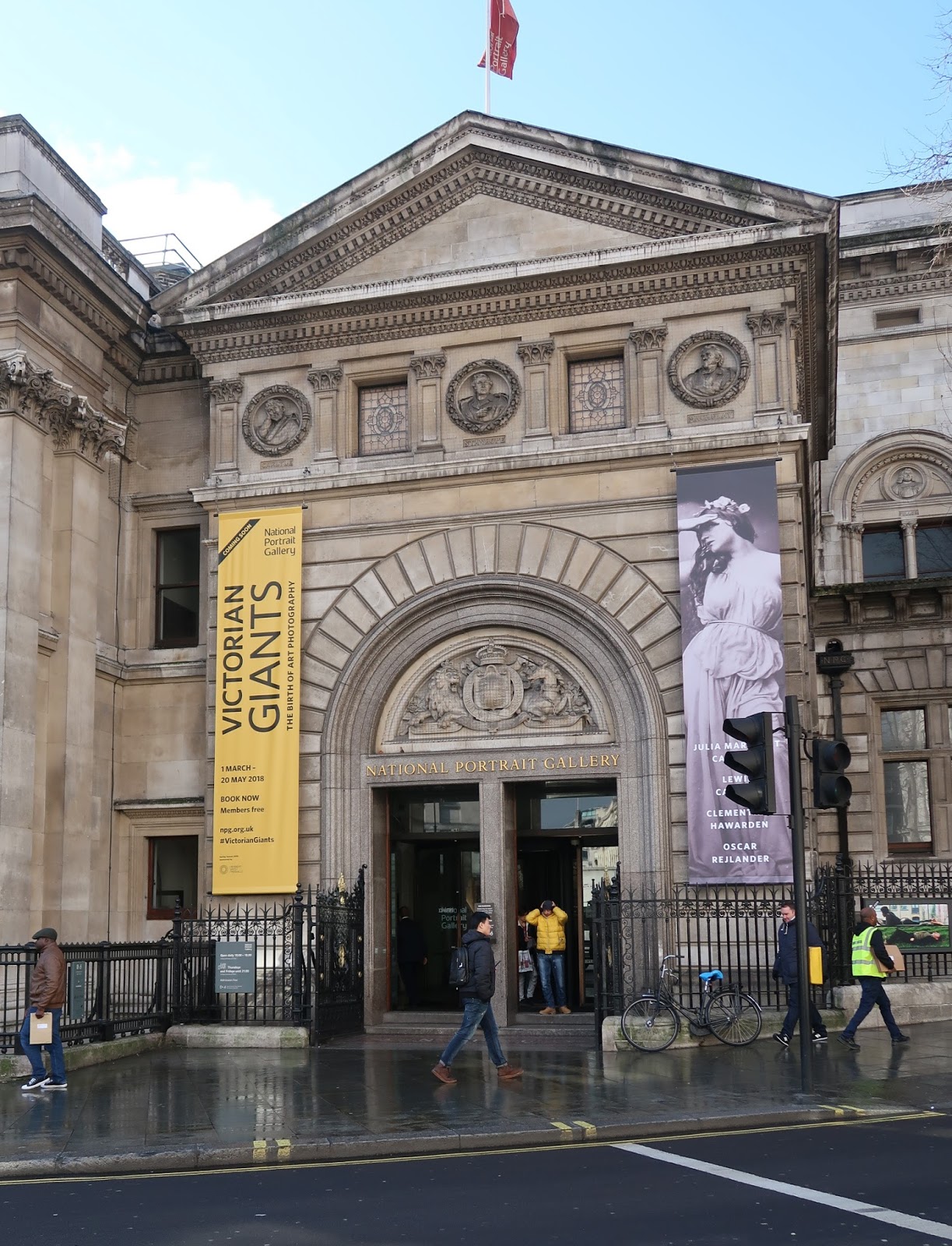
National Portrait Gallery - CityLit course

NPG not the poor relation of The National

Yesterday was the first session at London's National Portrait Gallery with city Lit Course VB151 - and what a good time I had with it.

It was a cold day but worth making the journey!


A Gull made it into London too


As I found with the last Gallery tour course (around the corner at the National Gallery) Leslie Primo, the course leader is not only a talented communicator on Art he is also very well organised when it come to running classes - this time he was there with handouts and registers and explained the structure which is a chronological run through of some of the important works at the NPG.


 A good mixture of people in attendance and as well as those who have paid and enrolled there were a number f visitors who latched on to the explanations.


The first session was very much about portraits of  English Kings, Queens and some nobility.

A selection of paintings of English Royalty

Early paintings (on wood rather than canvas) were not attributed to an 'Artist' and were often copies of other likenesses doing the rounds.
A more 'natural' approach

As painting developed European influences meant that standards were improved and new techniques became accepted, some artists worked on canvas and became known for their particular approach.

There was (it was agreed) even then a tension between imported talent (artists sometimes  fleeing religious persecution)  and bringing on 'homegrown' artists.

Many of the artists from Germany and the low countries were able to show great skill in their work, they often had a more natural approach to their subjects  and by virtue of their talents  became 'court' painters (like Holbein) often taking English nationality (to lower their taxes).

It was really interesting to see a number of paintings of Elizabeth I which reflected the audience they were aimed at (some personified her as England).

Not all paintings made reflected how she aged or her waist size!


A Portrait of Elizabeth 


Sunday, February 25, 2018

CityLit new Prospectus and Do Ethics point towards a 'greater being'?


Come on in
It was week 6 of Ethics class on Thursday - slightly less people there than previously but Ariel was on fine form running about 15 minutes over!


As promised the topic is not an easy one but perhaps all the
more worthwhile because of that!


What is in my mind (and it changes week to week) is if there is such a thing as 'Good' then surely there's also evil and does it mean that there'a greater 'entity'?


Over the last 5 or so years I have had some great times at the college - it really is to be celebrated as well as the on-site courses there are some great opportunities to visit London galleries as part of a group.


Tomorrow I start with them a short course (off site) with the illustrious Leslie Primo looking at some of  the works in the National Portrait Gallery, previous experience on a course led by Leslie means I anticipate a great and well planned series of visits.

New Spring prospectus is just out - if you're able to make it to the college (London Area) I'd really recommend it amazing range from Swahili to Sign Language (and so much more) - very safe and supportive environment .


Sunday, May 08, 2016

National Gallery (vb 150) and Red 177

Last week I attended the first session of a National Gallery course run by the City Lit, the course is led by Leslie Primo an experienced articulate specialist in Art lecturing and presentation.


We started the course with a brief introduction to the building and how it has evolved (with multiple extensions at the back) and of course that new Sainsbury wing with its' nods towards the architecture in the original façade.


The gallery was actually as is so often the case with public buildings made on a tight budget - bits taken from other projects and corners cut  but unlike
The referential Sainsbury extension 
many of the other national galleries across Europe it was at least purpose built.


In fact the Prince of Wales probably raised some very good points and the building fits in with the general environment around Trafalgar Square, Leslie pointed out that the big failure was that the extension was conceived before the days of the 'blockbuster' exhibition and no big space was made in the addition.


The Gallery -A purpose built home


Once inside the gallery Leslie explained how the extension was modelled (full size) at Pinewood (Studios) and the resulting perspectives seen have been  used to highlight some of the works in the Gallery extension.

I'm hoping to get from the course three main things

1) A better appreciation of composition - by looking at the 'Masters',

2) A feel for the sweep of development of Western  Art against the backdrop of changes in society,

3) The changes in materials and methods employed by the artists,

and of course a familiarity with some of the major works and the artists behind them.
I'm pleased to say it started well, the gallery is organised on a chronological  basis (which of course has some problems) and during the first session we saw some religious works aimed at a largely illiterate church going population.

The works often described as primitive showed narrative and employed conventions to highlight themes.

The painting we saw (in detail)  first was The Virgin and Child Enthroned  (reference NG564) at this time artists were not credited and this work was (as was the practice then) painted on wood.

We also looked at the impressive Crucifix by Segna di Bonaventura (NG567) which would have hung above a church Altar it was clear to see that anatomically and emotionally development had taken place when compared to the nearby Crucifix

Thought to be (possibly) the earliest English work on show 'The Wilton Diptych' is painted on Oak, a pointer to UK provenance it's a two part-er which includes a representation of King Richard against a scene which features the infant Jesus (with Mary).

The painting is thought to emphasise a connection between Royalty and Christianity it use expensive paint and gold leaf.

I'm looking forward to more highlights next Thursday!

[One of the great things about the National Gallery Website is the ability to see fine reproductions, by reference number  online that can be searched and zoomed in on to see the details.]

Red 177

In the heart of London saw this temporary arena

A large number of red flip down chairs