Well tomorrow's the second session on 'Pragmatism' in City Lit's tour of 20th Century Philosophy so I decided to see if I can get any closer to capturing something of the intention ahead of class:
 |
| Important |
 |
| A useful reference |
Probably useful to start again with the time line of what is known as Pragmatism but I will add this time the precursors and successors so:
Kant (precursor)
C S Peirce (relabelled it Pragmaticism when he felt it had strayed from the earlier conception)
William James
John Dewey (Decided instrumentalism was a better term)
Rorty
Dennett
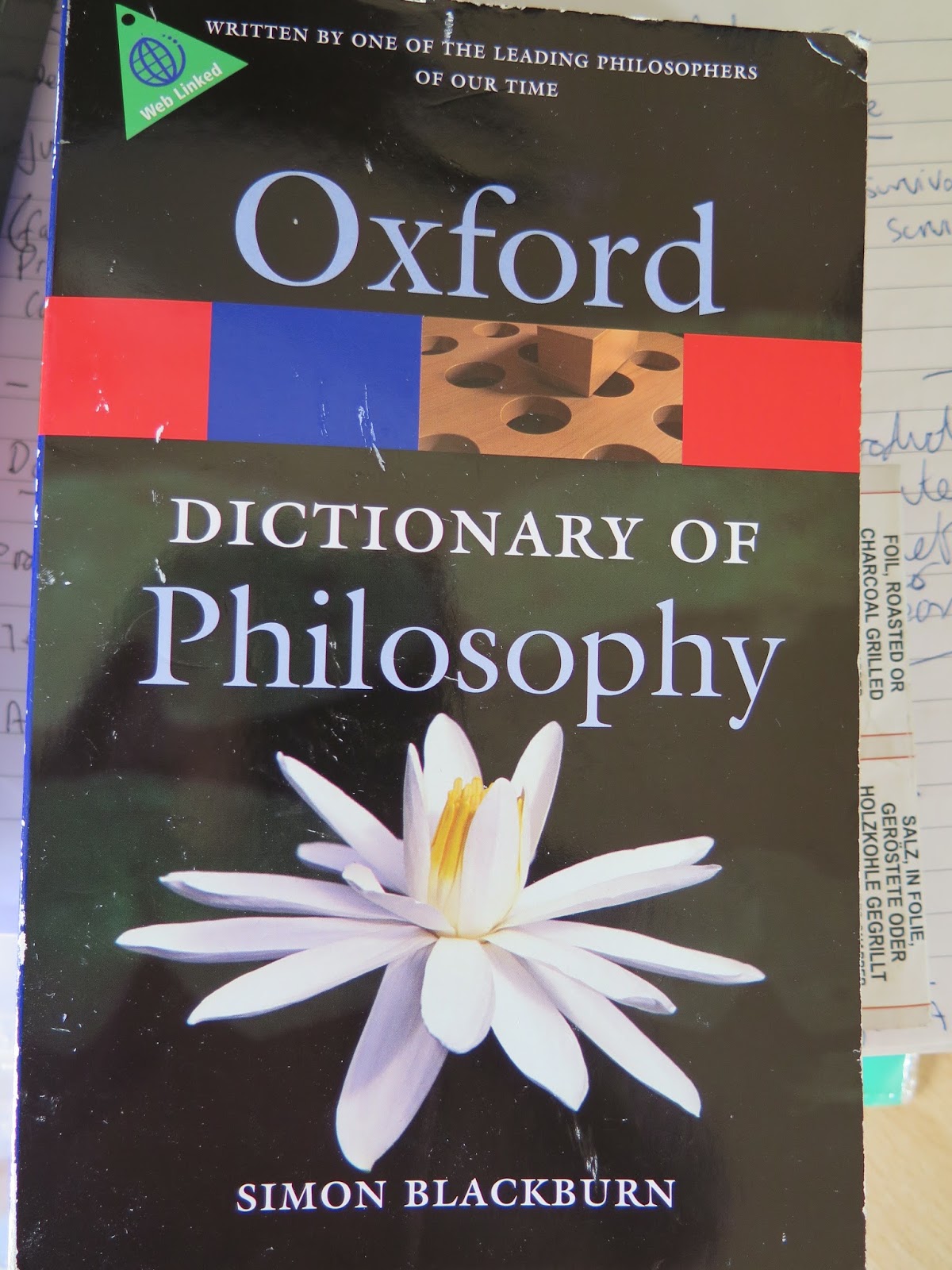
I kicked off with looking at a dictionary definition (the Oxford Dictionary of Philosophy nonetheless) - well as you can imagine this was not an answer in itself, it did though hint at the schisms within what is known as Pragmatism and allude to the influence of Kant and reference
F C S Schiller's Pragmatic credentials .
 |
| And pleased to meet you |
Another book that provides an interpretation is
Introducing Philosophy by Robert C Solomon, it says:
pragmatism
A distinctly American philosophical movement founded by Charles
Sanders Peirce at the turn of this century and popularized by William
James and John Dewey. Its central thesis is obvious in its name,
that truth (etc.) is always to be determined by reference to
practical (pragmatic) considerations. Only those metaphysical
distinctions that make some difference in practice are worth
considering, and the only ultimate defense of any belief is that "it
works."
and a further (perhaps easier) view of Truth within Pragmatism is 'defined' by what William James says from
John Lewis's interpretation in 'History of Philosophy' as:
.. the truth about God, or Freedom, or Immortality. Nor can we
disprove these things of course. Yet it is important whether they are
true or not. If they are true, then life is enhanced ; if they are
not true, we live in doubt and may die in despair. Why not see
whether we can live as if they were true? Why not bet on the most
optimistic hypothesis ? We can lose nothing. If in the end we are
wrong, we have lived our lives hopefully at any rate. If we are
right, then we have happiness both in this world and the next. Let us not say we will only believe what can be proved to be true. (page 152)
Pragmatism seems to have been prone to being renamed and Schiller embraced much of what James categorized as Pragmatism but he himself preferred to called it Humanism.
Kant
Kant can be viewed as a Pragmatist starting point as C S Peirce did and in fact there are (of course) papers extolling Kant as a pragmatist one (
Kant and Pragmatism by Sami Pihlström) includes this on James
William James famously wanted to see philosophical progress as going “round” Kant instead
of going “through” him. However, pragmatism – even James’s own pragmatism – shares
several crucial assumptions with Kant’s critical philosophy, to the extent that Murray
Murphey was justified in calling the classical Cambridge pragmatists “Kant’s children”.
C S Peirce
Pierce was an interesting character and as well as being something of a libertarian in his private life was said to be a drug user*. he was though highly able and something of a polymath in his academic career, one of his disciplines was Logic and his belief was that Philosophy should be 'based on Mathematical Principles'
[ from
Charles Sanders Peirce -A life by Joseph Bent * "His father... regularly used ether and opium... He introduced their use as palliatives to his son, who also used them regularly, and in time added caffeine, alcohol, morphine, cocaine, and other drugs, all of which were available without prescription until 1914, the year of his death. Charles became a sophisticated multiple drug user and, by the time he was forty, if not earlier, an addict."]
William James
James was a psychologist and a religious man, not surprisingly as the brother of Henry he was also a more than capable writer. (You can find out more about him with
Melvyn Braggs' In Our Time).
Hi own ideas for Pragmatism glory in their rejection of exactitude and are perhaps stretched to permit his own religious views to survive its rigours
John Dewey
Dewey led a long life and brought Pragmatism into the second half of the 20th century, one of the things he did was connected 'Art' to Pragmatism - (odd that as a result of it's vintage looking at
one of the books I own he's a contemporary figure!)
Here's what it says :
Dewey has
pointed out that a theory is essentially a guide to
action. The object of
intelligent conduct, that is to say,
conduct guided by a rational view of things, is to discover forms
of action by which all the values of life are extended and
rendered more secure, including the diffusion of the fine arts
and the cultivation of taste, the processes of education and
all activities concerned with rendering human relationships
more significant and worthy. Problem solving solutions,
in this sense (and not meaning solutions of mere intellectual
puzzles) have a claim to
truth, to ' warranted assertibility
'.
Rorty
I found
Richard Rorty ( a living Pragmatist one might say) useful as a commentator, he says that Pragmatism is
'Not going beyond senses'
and that there's
'Nothing to be said about Truth (like God)'
Rorty also places the Pragmatist historically saying that at a time of progress the requirement for philosophical answers changes as we anticipate a better time for our descendants.
Bertrand Russell and concluding
Of course any philosophical thread of value has its detractors and Pragmatism had a powerful opponent in the British Philosopher Bertrand Russell who said..
"James is committed to the truth of ‘Santa Claus exists’ (Russell 1949: 772)"
My problem is more that Pragmatism does seem to be a big church and riddled with inconsistencies depending who you take as your reference
[
Footnote 1- How lucky many of us are to have to hand things like scanners linked to
OCR- I recall my first hand held scanner attached to a PC around 20 years ago when I was in France - we've made big steps forward on this -
Voice recognition is still facing challenges though]
[
Footnote 2 Transubstantiation- really finding this 'idea' and the split of the church it epitomises as interesting - The big question for me is how it can be accepted today and conversely how for some if you have 'faith' you might wish to deny it.]