Saturday, December 06, 2014

The Design Museum - One Laptop per Child project (stop 3)

Somewhat different from the three  items previously introduced as part of a potential tour at The Design Museum is the development initiative that is 'One Laptop per Child' an ambitious idea to get Computers to youngsters in the developing world.
A bit of a check-list for 'One per Child'

The idea I have is to look at this in conjunction with the nearby sign-age detailing some of the issues that crop up around such plans.

The project goal was for each child  to be able to access a rugged, low-cost, low-power, connected laptop quite a goal.

When electronic computers first escaped from the University IBM reckoned the world market would be well below 100 and famously the computing power of  a modern smart phone outperforms what computing power got the USA's NASA to land a man on the moon in the 1960s -so why should it now be seen as so important to emerging economies?

Well computers and more importantly  Laptops are reckoned to be a 'window' in terms of communication  and a tool: to help them thinking and discovering. Laptops are a  way for youngsters to learn through independent interaction and exploration and the 'One Per child' idea is continuing  in new iterations. 


The laptop as it's seen at the Design Museum

Thursday, December 04, 2014

Conflict Time Photography and 1b) recycling Fasion

Lord Olivier in Statue
On Tuesday I walked across from Holborn to The Tate Modern by the river, it was a coolish day but dry and pleasant.


The reason for my walk was to take a look at the Tate's exhibition 'Conflict Time Photography' it's an impressive show and made me reflect on the printing I'd been looking at earlier in the week, some of the prints on show were both large and impressively detailed not sure what machines are used to do this but they must be quite something.

Unusually I only spent time in the exhibition rather than looking at other new or favourite works which perhaps gives you some idea of the scope and power of what's on show.
It certainly takes time

The exhibition is structured (mainly) around time after the height of the action in war zones.

Some of the photographers who caught my eye were Sophie Ristelhueber (Fait) and Hiromi Tsuchida's moving images from the Hiroshima aftermath but really there are far too many powerful images to mention here.


1b) Miyake's recycled materials 

The second object an alternative starting point for The Design Collection is Issy Miyake's dress made from recycled materials this makes us aware of the designer's ability to shape opinion (here on the the intent to reduce the use of resources).
Recycled dress

Miyake as a recognised name is able to make a statement in more than just a dress but also in the selection of material, arguments could be made on if this is 'Green washing' but regardless of the volition one can admire the craftsmanship and  style.

Wednesday, December 03, 2014

Philosophy - pushing at the edges and Item 1a) on the Design Tour

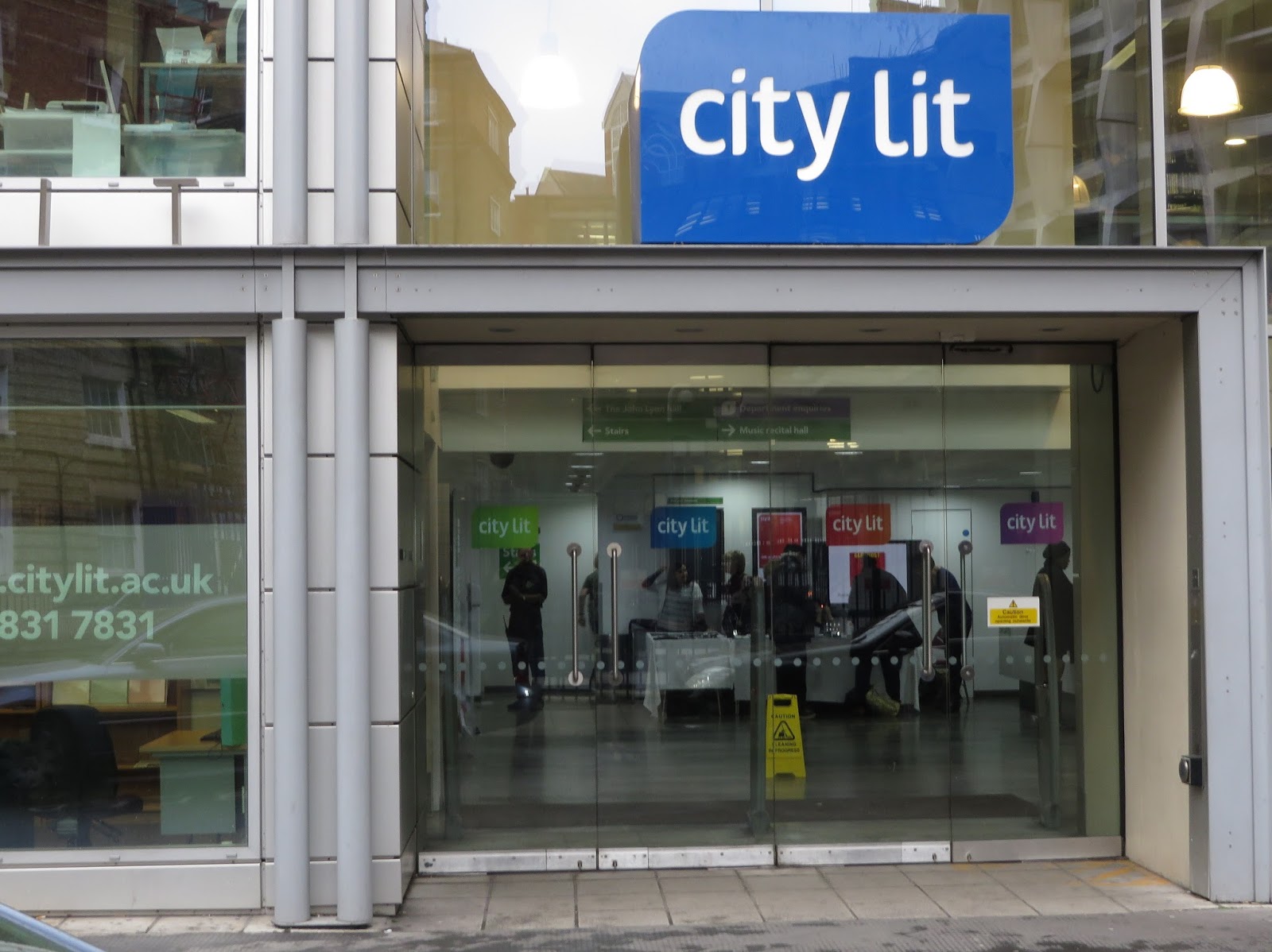
Well as we've reached the end of Nagel's 'What Does it all Mean' in our CityLit Key Themes class there was an opportunity to move beyond the barriers of the traditional Western philosophy to put our delicate feet into the pool of what might be considered Eastern Philosophies.
The Doors of Enlightenment 

The reading and videos associated with the penultimate session were around Buddhism and these from a Japanese/American  perspective featuring a brace of Suzuki's (Messrs D.T. and Shunryu Suzuki) - well I took some time ahead of the lesson and read and watched what I could,


I was somewhat puzzled by the nature of what they said and was hopeful of illumination from the class.


What concerned me was 'is this philosophy - it felt in places from the descriptions and debate that Buddhism might be more like a religion, which I'm somewhat embarrassed to admit set up my hackles.

Playing against this view some of what was described did seem to relate to the questions that Philosophers in the Western tradition had asked but the answers offered seemed to be more associated with sacred texts than  'conclusions' reached at by the probing of solutions with rational arguments.

Scott (our teacher) had some challenges in bringing the idea to the class, he described the practice of Zen Buddhism from his own experiences and another of the class described his experience in Wales (this one perhaps?) of taking part in a Buddhist retreat (my description) where mobile phones were not permitted and participants were taken away from distractions  and therefore required to 'confront themselves'.

Scott also spoke about The Archer Paradox' where the divisibility of space  points towards separation being something of an illusion.

He also posited that Western Philosophy was typically about what can be described in words (it does sometimes seem to get bogged down in this) whereas the Eastern Philosphy was (perhaps) more experiential.

While I felt that the lesson was worthwhile my 'personal' view is that those who 'use' such methods are using a 'coping' tool much as those in the business of Freudian and other analytical  Psychology  might argue against CBT (Cognitive Behavioural Therapy)  as a full answer to Psychological issues.

[Footnote: Odd that the excellent  In Our Time (with Melvyn Bragg) should be looking at Zen as part of its examination of influences this week]

 Item 1a) on the Design Tour

And that Museum

Well I'm beginning to put together my first go at a Design tour and today I visited the Design Museum again, I've decided to have two possible openings, one uses The AK47 as the first element .

That gun
The selection is  perhaps controversial but should help get people engaging with the issues.

The designer of the AK 47, Mikhail Kalashnikov died earlier this year - he is said to have regretted that the design which he's remembered was an effective machine for killing people.


What we might note from the success is that it has performed it's task well it has been used for something more than 60 years and it remains iconic where guerilla warfare  is undertaken.


Tuesday, December 02, 2014

Penultimate Digital Photography session- Getting the story and getting the print

Last week in our photography class we were given a couple of pictures to analyse (described by me here as Geisha and 'Running Boy' both by Steve McCurry), my analysis went something like this- 

Line (that of the eyes of the protagonists for example).
The line in the pictures by Steve is drawn first to the human figure which  in both cases is fairly central.

Colour  The colours used are expressive, from my perspective I would associate the red of the Geisha with anger and ferocity but the cold fluorescent light drains emotion from the scene.

The blue (cool) that predominates in the running boy  figure picture though is balanced by the red hands, overall the blue seems oppressive and 'dark' the shadows are muted .

Shape Shape is an important element within both pictures – giving the subject in both case a route out but placing them 'centre stage'.
Form both pictures show a figure in motion one appears concentrated on the manner of the movement while the other is more concerned with the result of the motion

Tone – in the Geisha picture the electric lights give a flat even lighting and shadows are muted there is an accent on purpose by the subject– the more natural and nuanced light in the boy picture is more emotive leaving a focus on the boy being the subject being acted on by circumstances.


Texture there's a real contrast between the two walls that form a strong texture to the two pictures for the geisha the walls are almost clinical and detached giving a strong contrast to the human figure for the child picture the walls seem to form a different sort of labyrinth one that does have more of a human character but not necessarily a benevolent one

Space The Geisha dominates the space within her picture whereas the child appears (to me) to be a subject within the space

Depth -The handrail in the geisha picture provides a feeling of depth with its gradient and reflections other materials feel flatter. The Child's position is located by the right hand brown wall counter-pointed against the blue wall to the left


Focus The Geisha exists within a slowly tapering fields of focus , the writing on the wall signs is out of focus but can be read (exit) – the focus on the boy picture is similarly dispersed (as far as I can see)

Pattern the walls both have patterns the geometric pattern of the subway tiles on the walls anf ground is like a washable surface, functional rather than aesthetic uniform and 'cold' it even lacks graffiti – the stainless steel of the handrail too is industrial and cool

and

Viewpoint, The geisha figure is being looked down on as she climbs the stairs her eyes are averted from the camera and the make-up means her facial expression is hard to read.
The boy is seen in retreat be is alon and small in the frame (his height is about one quarter of the picture)

along with how we feel about the picture/s we're analysing.
Both pictures have a helical structure, in one (the Geisha) the subject is moving in a clockwise way to be at the centre of the 'stage' while the child in the other is moving away in a counter clockwise way and although the child's movement could be interpreted as a joyous skip and run there is an alternative interpretation that has flight in it.  

Outcome - well the exercise was really useful and reminded me of what I like in pictures, here are couple of mine that I like because they invite a narrative.


There are a  few stories in here


Window shopping story here


Printing Press


Let me in!
After a few years away from the constantly changing Ealing College (it's apparently the University of West London now) I renewed my acquaintance with the halloed institution yesterday for the penultimate OPEN Ealing photography session.


I went to the college for a video course in the 1990s and have also used the Library when I was doing an MA by Distance learning, and more recently I've attended a few public events there too.


We got the chance to have a play with the Photoshop software and select the pictures (3 of these each) to Print for display in next week's exhibition - the good news is that looking on the 'Macs' we were using, after an earlier lack of confidence in myself, my pictures  and my camera I really liked the way my pictures looked - no need for too much adjustment and they capture my continuity theme of some views in Ealing nicely.